

Know what is happening now, not what happened last month.
Most operations run on reports that arrive after the decision had to be made. Operational Intelligence puts orders, exceptions and delays in one live view, automates the routine responses, and leaves the judgement calls with your team.
The problem it solves
Someone calls to ask where their order is, and answering takes four minutes and three systems. A delivery goes wrong on Tuesday and leadership hears about it on Friday. The status of the operation lives in one person’s head and in a spreadsheet they keep on their own desktop. None of this is a technology problem to begin with — it is a visibility problem, and it gets expensive quietly.
What it looks like in practice.
01 Connect what you already have
Your order system, your telematics, your spreadsheets, your email. We work with the systems you run today rather than asking you to replace them.
02 Reconcile into one view
The same order should not have three statuses. We resolve the conflicts first, so the view everyone works from is the same view.
03 Automate the routine
Status answers, exception alerts, the reports somebody rebuilds by hand each week. The repetitive layer comes off your team’s desk.
04 Keep a person in the decision
Anything that affects a customer, a cost or a commitment surfaces for a human to decide. Every automated action is logged and reversible.
One Workflow in Weeks, not Quarters
We do not begin with a platform rollout. We take one workflow that costs you real time every week — order status, exception alerts, the report somebody rebuilds by hand — and put a working version of it in front of your team in a matter of weeks, running on your own data.
You see it working before anyone commits to anything wider. If it earns its place, we extend it. If it does not, you have lost weeks rather than a budget cycle.
-
A focused review of your data, workflows, and the decisions that cost you most. We’re looking for where the signal is clear and the value is real.
-
One use case, chosen for measurable value and manageable risk. Not the flashiest option — the one that earns its place.
-
A working solution built on your data, with governance and human oversight built in from day one. Your team uses it; we don’t hand you a deck.
-
Agreed success metrics, tracked honestly. If it worked, you’ll know why. If it didn’t, we’ll say so.
How Ainfore supports key industry sectors
Manufacturing
Production reporting, quality records and maintenance logs that currently live on paper or in one supervisor’s workbook.
Logistics and Distribution
Order status, delivery exceptions and carrier invoice checking, without the phone calls.
Food service
Demand, ordering and waste across locations, in one view instead of per site.
Nonprofit
Programme and donor reporting that stops consuming a week of someone’s month.
What we build
Ainfore Logistics Intelligence
For logistics operators, we have packaged the common parts into a working platform: live order and shipment status, exception handling, carrier performance, and the reports most operators rebuild by hand. It is configured to your operation rather than installed as-is.
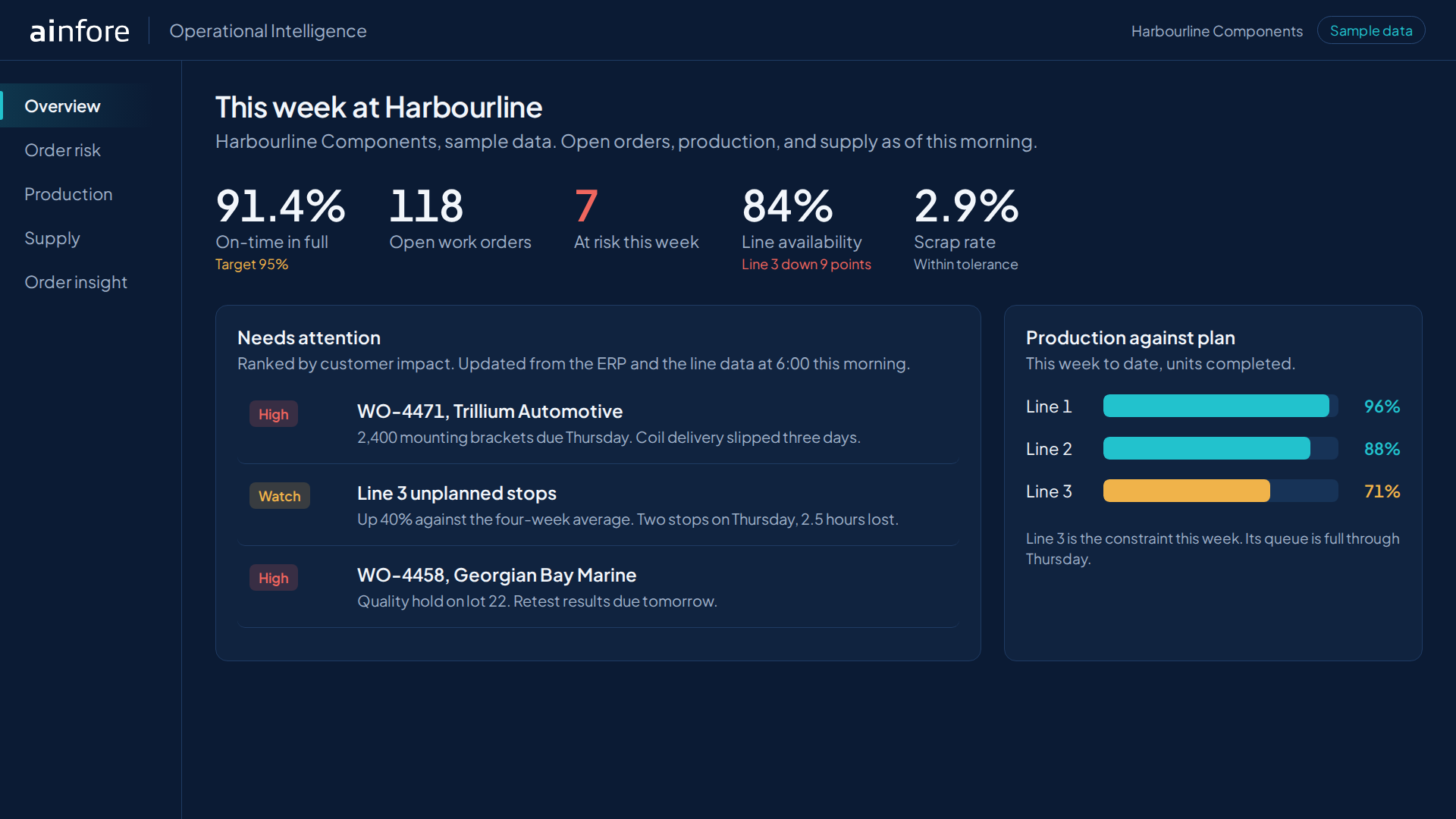
Ainfore Logistics Intelligence, shown with demonstration data. Live deployments are configured to the customer’s own systems.
Ainfore Logistics Intelligence, shown with demonstration data. Live deployments are configured to the customer’s own systems.
We design and build operational intelligence systems that give your team a live view of what’s happening — and alert them when something needs attention, before it becomes a problem.
Live operational dashboards: Single source of truth across your key workflows
Automated exception alerts: The system flags the issue; your team handles it
Workflow automation: Routine tasks run without a person pushing them through
Reporting that reflects now. Not last week’s data cleaned up in a spreadsheet
Everything is built with governance and human oversight included. Your team stays in control. The system handles the repetitive, the routine, and the urgent-but-missable.
We don’t automate a broken workflow. We fix the data first. Then automate.
Governance
You will know where your data sits, which services touch it and what is retained — in writing, before anything is connected.
Every automated action is logged, attributable and reversible.
Nothing that affects a customer or a cost happens without a person approving it.
Start with one week of your own data.
The fastest way to know whether this is worth it is to look at a single week of your real operation and count what it cost to answer the questions that came in. We will do that with you on a call.